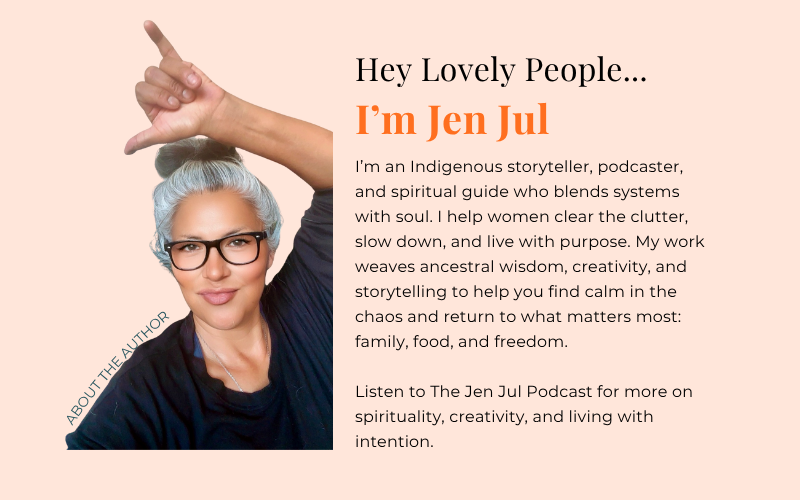
Why I Left AI for a More Rooted Life in a Disconnected World

This Was Not a Rebrand. It Was a Reckoning.
I do not hate technology. Actually, far from it.
Nor am I here to shame your phone. I have one too.
But I stepped back from AI and tech-heavy spaces because something in me started to feel hollow.
Not tired.
Not confused.
Hollow.
Like my work was feeding a system that rewards speed, output, optimization, and attention extraction. And the more I leaned in, the more it felt like I was living inside a machine that never asks the most human question:
“Are you OK?“
The strange tension I could not ignore
Here is the strange part.
AI is impressive. It is useful. It can save time. It can solve problems. It can support accessibility.
And still, for me, the culture around it began to feel soulless to me.
More competition. More noise. More “be first or disappear.” More urgency disguised as innovation.
More emphasis on scaling, stacking, outperforming, monetizing, and turning every part of life into content.
Meanwhile, people are not doing great.
That is not a vibe issue.
That is a public health signal.
We are “connected” all day, and still lonely
We are surrounded by content. Messages. Feeds. Notifications.
But research keeps circling the same pattern: heavy social media use, especially when it includes frequent comparison, lines up with higher depression and anxiety symptoms.¹
And when social comparison is baked into the experience, upward comparison in particular, it is linked to lower self-esteem and more depressive symptoms.² ³
This is the trap.
Your brain thinks it is gathering information.
Your nervous system experiences it like a constant ranking system.
Am I enough?
Am I behind?
Why does everyone else look better at life than me?
Even if you “know it is curated,” your body still reacts.
Burnout is not a personal failure.
Burnout is not a lack of resilience.
It is not a mindset issue.
It is not because people are fragile.
The World Health Organization describes burnout as an occupational phenomenon tied to chronic workplace stress that has not been successfully managed, with exhaustion, mental distance or cynicism, and reduced professional efficacy.⁴
Translation:
You are not broken. You are responding normally to abnormal conditions. You are human.
And tech has a particular way of making burnout feel normal, because it hides the cost behind convenience.
This is where “technostress” comes in.
Researchers use this term to describe strain created by digital work demands, especially in remote and always-connected environments. Studies link techno-stressors to burnout and poorer psychological health outcomes like depressive mood and anxiety symptoms.⁵
Not because people are fragile or people cannot handle tools.
Because the pace is relentless.
The always-on world has a name for what it does to you
In occupational research, technostress often shows up as:
Techno-overload. The pressure to work faster and longer because tech makes it possible.
Techno-invasion. Work bleeding into personal life through devices and constant reachability.
Techno-complexity. The cognitive load of learning, managing, and juggling tools.⁶
That list reads like modern life.
And it matches what so many of us feel but cannot explain:
Functioning on the outside.
Fried on the inside.
The deeper issue is not technology
The deeper issue is what technology quietly trains us to believe.
A lot of modern platforms are built on metrics, vanity metrics if you will.
Views. Likes. Saves. Followers. Opens. Clicks.
And when your environment is built on performance signals, it is easy for your worth to become performance-based, too.
Research in digital contexts keeps pointing to the role of comparison and curated content in psychological distress and reduced self-worth.³ ⁷
This is how even “self-care” gets hijacked.
Your morning routine becomes content.
Your healing becomes a brand.
Your rest becomes something you must earn.
And AI, in the wrong hands, accelerates that.
It can increase and amplify the output without ever asking WHAT the output is costing your actual life.
Why I shifted
I chose something different because I want to live like a human again.
I want to live at the speed of seasons, not software.
I want my work to be in service of wholeness and enoughness, not scarcity and comparison.
And I want my corner of the internet to feel like a porch light.
A place of connection.
Not a leaderboard, dashboard or a whiteboard.
So I created Rooted.
Not as a fantasy life.
As a return.
Rooted is not anti-tech. Rooted is pro-human
This distinction matters.
Rooted is not a “delete everything and move to a cabin.” (although tempting;)
Rooted is not rejecting the modern world.
Rooted is boundaries.
Rooted is discernment.
Rooted is a different way to live.
Rooted is choosing what gets access to your attention.
There is growing research around slow living, slow media, and intentional digital disconnection showing that bounded tech use supports presence, deeper relationships, and a stronger sense of meaning.
Research on slow travel and digital disconnection describes how tech-limited spaces can support presence, shared experience, and deeper immersion in place and relationships.⁸
People are not asking to abandon technology.
It shows they are seeking bounded spaces where constant connectivity does not dominate their nervous system or attention⁹.
Rooted responds to that need.
Not by fighting technology.
But by creating space to breathe inside modern life.
What Rooted actually offers
Rooted is my framework for returning to yourself in a disconnected world.
It is built around six pillars that bring you back to what is real:
- Your Mind.
- Your Time.
- Your Movement.
- Your Spirit.
- Your Home.
- Your Income.
Not as hustle tasks.
As roots.
If you feel fine but numb.
Capable but scattered.
Busy but disconnected.
Overwhelmed but unable to stop.
You are not alone.
There are names for what you are experiencing. There is research behind it. And there is also a way back.
A simple place to start today
Try this for the next 24 hours.
Turn off non-essential notifications.
Do one thing with your hands. Cook. Fold laundry. Bake bread. Plant something.
Go outside for ten minutes with no phone and no plan.
Write one honest sentence: This is what I actually need right now.
That is Rooted.
Not aesthetic.
Not optimized.
Real.
Why I Created the Rooted Guide
I created Rooted because reconnection is no longer optional.
Burnout, loneliness, and anxiety are rising, even as our tools become more advanced. Research is finally catching up to what many people have been feeling in their bodies for years, especially women.
Rooted is not a system to master.
It is a framework for remembering.
Your body.
Your time.
Your values.
Your relationships.
Your place in something larger than output.
It does not promise speed.
It offers something steadier.
A way back.
A way to live from connection and wholeness.
A way to remember that you are already enough.
Where I Am Standing Now
I still use technology.
I still understand AI as a tool.
I still respect innovation.
But it no longer sits at the center of my work.
Life does.
Connection does.
Wholeness does.
If you feel pulled toward something slower, quieter, and more grounded, you are not falling behind.
You are responding wisely to a world that has forgotten how to pause.
And if you are looking for a place to land, Rooted is here.
Start Living Rooted
The Rooted Guide is the deeper walk. It is the map. It is the return.
If you are ready for a slower, more connected way to live, work, and create, you can start here:
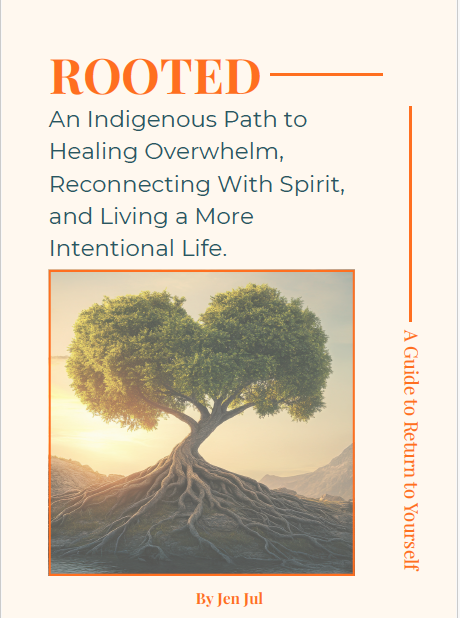
Get the Guide
Return to Yourself
Start Living Rooted
References
- Grand Rising Behavioral Health. (n.d.). The impact of social comparison on mental health.
https://www.grandrisingbehavioralhealth.com/blog/the-impact-of-social-comparison-on-mental-health - LeBlanc-Brillon, J., Fortin, J.-S., Lafrance, L., & Hétu, S. (2025, August 8). The associations between social comparison on social media and young adults’ mental health. Frontiers in Psychology.
https://pubmed.ncbi.nlm.nih.gov/40861344/ - Nowland, R., Necka, E. A., & Cacioppo, J. T. (2018). Loneliness and social internet use: Pathways to reconnection in a digital world? Perspectives on Psychological Science, 13(1), 70–87.
https://pmc.ncbi.nlm.nih.gov/articles/PMC9295248/ - World Health Organization. (2019, May 28). Burn-out an “occupational phenomenon”: International Classification of Diseases.
https://www.who.int/news/item/28-05-2019-burn-out-an-occupational-phenomenon - Consiglio, C., Borgogni, L., Di Tecco, C., & others. (2023). Techno-stress creators, burnout and psychological health among remote workers. International Journal of Environmental Research and Public Health.
https://pmc.ncbi.nlm.nih.gov/articles/PMC10671499/ - Tarafdar, M., Cooper, C. L., & Stich, J. F. (2019). The technostress trifecta: Techno eustress, techno distress, and design. Information Systems Journal, 29(1), 6–42.
https://pmc.ncbi.nlm.nih.gov/articles/PMC10671499/ - Al-Azri, M., et al. (2025). Social comparison, Instagram use, and mental health outcomes. BMC Psychology.
https://pmc.ncbi.nlm.nih.gov/articles/PMC12606348/ - Syvertsen, T. (2025). Slow tourism and digital disconnection: Place, norms, and presence. Tourism Recreation Research.
https://www.tandfonline.com/doi/full/10.1080/11745398.2025.2539137 - The Embodied Approach. (n.d.). The art of slow living: Tap into your creative potential.
https://www.theembodiedapproach.com/blog/the-art-of-slow-living-tap-into-your-creative-potential