The Six Pillars of Returning
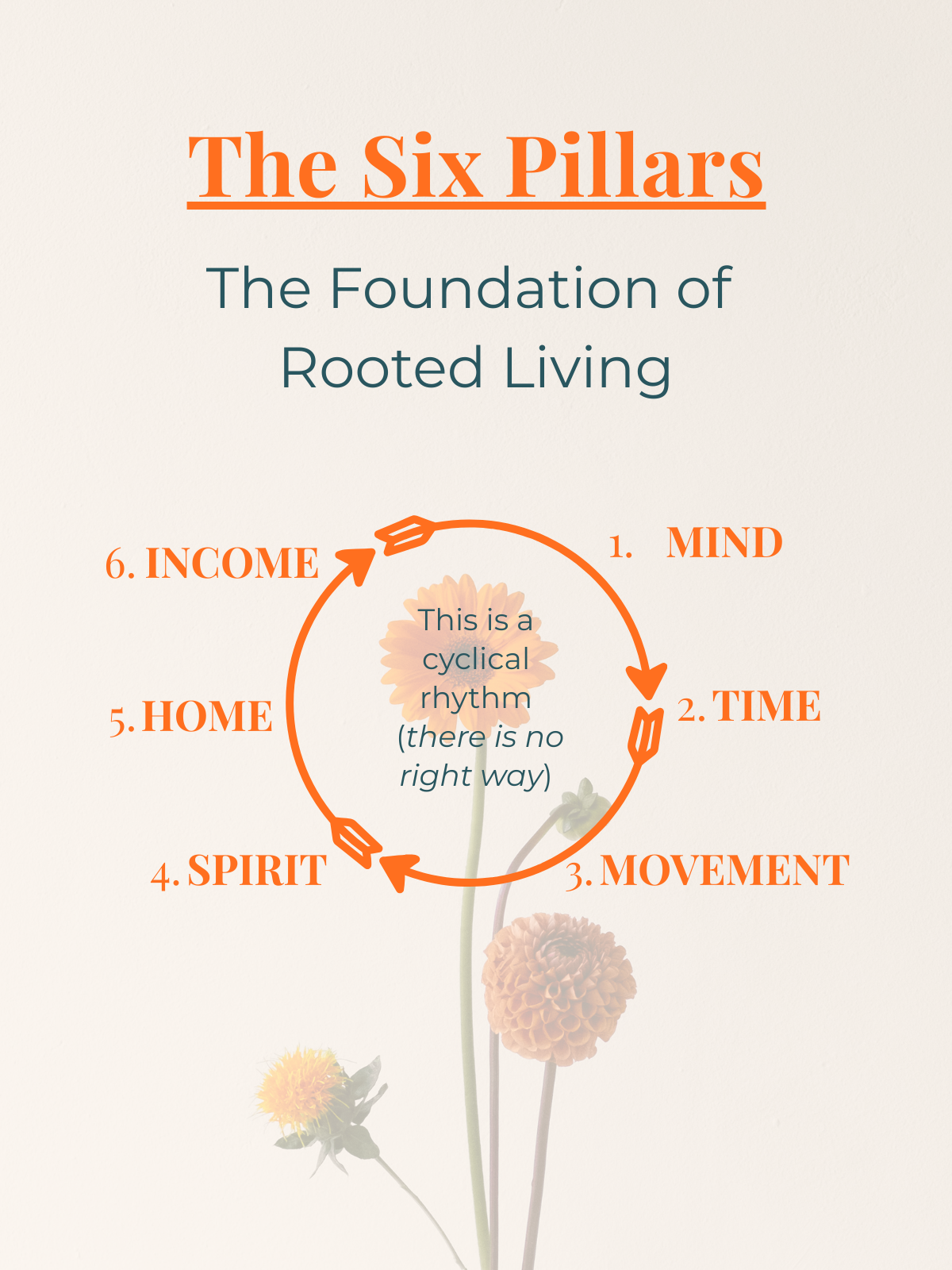
The Foundation of the Rooted Living
When I began writing the Rooted Guide, I was not trying to design a framework.
I was trying to survive my own disconnection with honesty.
I was asking questions that do not come from curiosity alone, but from lived tension.
Am I walking in a good way?
What happens when success costs your spirit?
What does healing actually require, not just promise?
I was not looking for inspiration. I was looking for something that could hold the weight of real life.
That search led me back to my ancestors, not as an abstract idea, but as a moral compass. How did they live before colonization fractured time, land, and community into separate categories? How did they organize life so that no single part carried the whole burden?
One of the most grounding texts I found was the Seven Circles – Indigenous Teachings for Living Well. What mattered to me was not just what it taught, but how it taught. Here were two Native American Indigenous people living modern lives without abandoning their ancestral intelligence. Not romanticized but lived and returned.
The Seven Circles reflect the land, ceremony, community, food ways, sacred space, sleep, and movement. Not as ideals, but as necessities. Reading it felt less like learning and more like remembering.
That book did not give me all the answers. It clarified what was missing.
And from that clarity, the Six Pillars of the Rooted Guide emerged.
Why the Six Pillars Are the Foundation
The Six Pillars are not a self-improvement checklist.
They are the structural foundation of a return to a more intentional life.
- Mind
- Time
- Movement
- Spirit
- Home
- Income
These are not categories you optimize once and move on from. They are roots. They are the deep foundation that you stand on. They require tending, repair, and return. Over and over again.
This matters because growth is not linear.
Healing is cyclical.
You do not fix your life and graduate from the work. You revisit it with more awareness each time.
What I noticed over the years of my own healing, and in walking alongside other women, is this pattern.
When life begins to unravel, it almost always starts in one or more of these places.
When life begins to stabilize, these same places are strengthened. Slowly. Imperfectly. On purpose.
This is why the pillars come first.
Before goals. Before expansion. Before meaning-making.
What It Actually Looks Like to Work With the Pillars
This is where most frameworks fall apart. They tell you what matters, but not what it costs to live it.
Mind
Mental clutter is not just overthinking. It is inherited narratives, survival strategies, and constant self-monitoring. Clearing the mind requires learning how to interrupt patterns, not replace them with affirmations (although that helps). It requires honesty about what no longer fits.
Time
Slowing down is not an aesthetic. It often means disappointing people, earning less temporarily, or letting go of urgency as a form of self-worth. Reclaiming time requires grief for the pace you were praised for.
Movement
Movement is not fitness. It is nervous system regulation. It is learning how to be in your body again after years of dissociation, productivity, or control. This can feel destabilizing before it feels grounding.
Spirit
Spirit is not belief. It is a relationship. A relationship with ancestors, guides, land, intuition, and silence. Rebuilding that relationship often brings discomfort before comfort. Spirit asks for listening, not performance.
Home
Your physical environment mirrors your internal world. Tending to your home means facing what you have avoided, accumulated, or ignored. It is not about minimalism. It is about safety and support. It’s about wanting to go home to a space that will hold you, not just your things.
Income
Income is where values meet reality. This pillar asks hard questions. What work costs you too much? What stability actually means. What alignment is required in a world that rewards extraction?
None of this is quick.
None of it is passive.
But it works once you get clarity on your money.
Why this Work Is Cyclical
You will return to these pillars in different seasons.
After burnout.
After grief.
After growth.
After change.
Each time, you see something new.
Healing happens not because you understand the concepts, but because you participate in the tending.
The Rooted Guide does not promise transformation without effort. It offers a structure that can hold real work.
The Rooted Guide as an Invitation
This guide is not about fixing yourself.
It is about tending what holds your life together.
It is about slowing down to remember that disconnection is not a personal failure, but a signal that something foundational needs care.
Rooted is how I learned to come back to myself after corporate chaos pulled me away from my spirit. It is how I live now. Not perfectly. Intentionally.
The Six Pillars are the beginning.
They are the ground you return to, again and again.
Soft Call to Action
If this way of living resonates with you, the Rooted Guide was created to gently and honestly guide you through this foundation.
Inside, you will find reflection, grounding practices, and lived context to help you tend each pillar in your own time, in your own way.
Not to become someone else. But to return to yourself, rooted.
You can explore the Rooted Guide here.
A slower, more connected way of living begins at the foundation.