Decluttering Your Life: Making Room to Live Rooted
January 30, 2026
Decluttering is not about having less.
It is about having enough room to breathe.
Many women approach decluttering as if it’s a house problem. Too much stuff. Too many piles. Drawers that no longer close.
But clutter rarely starts in your home.
It starts with how fast you are moving through your days.
Your attention.
The way responsibilities, information, and expectations keep getting added without space to sort or rest.
Decluttering, when done gently and intentionally, is not a clean-up.
It is a reset.
When we talk about decluttering here, we are not talking about one thing.
Rooted decluttering happens in three interconnected places:
your physical space, your digital space, and your mental space.When these three areas are tended together, the shift is noticeable and it creates space not just in your home, but in your body and attention.
Not dramatic.
Just grounded.
That’s it.
Why decluttering feels emotional
Decluttering is not just physical labor.
It is decision-making.
It is letting go.
It is confronting what no longer fits the life you are living now.
Research on cognitive load shows that excess visual and mental input increases stress and reduces our ability to focus and regulate emotions.¹
This is why clutter feels heavy even when you are not actively dealing with it.
Your nervous system registers it as unfinished business.
That discomfort does not mean you are bad at decluttering.
It means your system is seeking safety and resolution.
Your environment shapes how safe your body feels
Your home is not just a container for things.
It is an environment your nervous system is constantly responding to.
Environmental psychology research shows that visual clutter is associated with elevated cortisol levels, especially in women who already carry a high mental load.²
This does not mean your home needs to be minimalist or perfect.
It means your space needs to support how you actually live.
A rooted physical declutter focuses on:
• Clear surfaces that let you rest
• Fewer objects with deeper meaning
• Spaces that support rest, nourishment, and daily rhythm
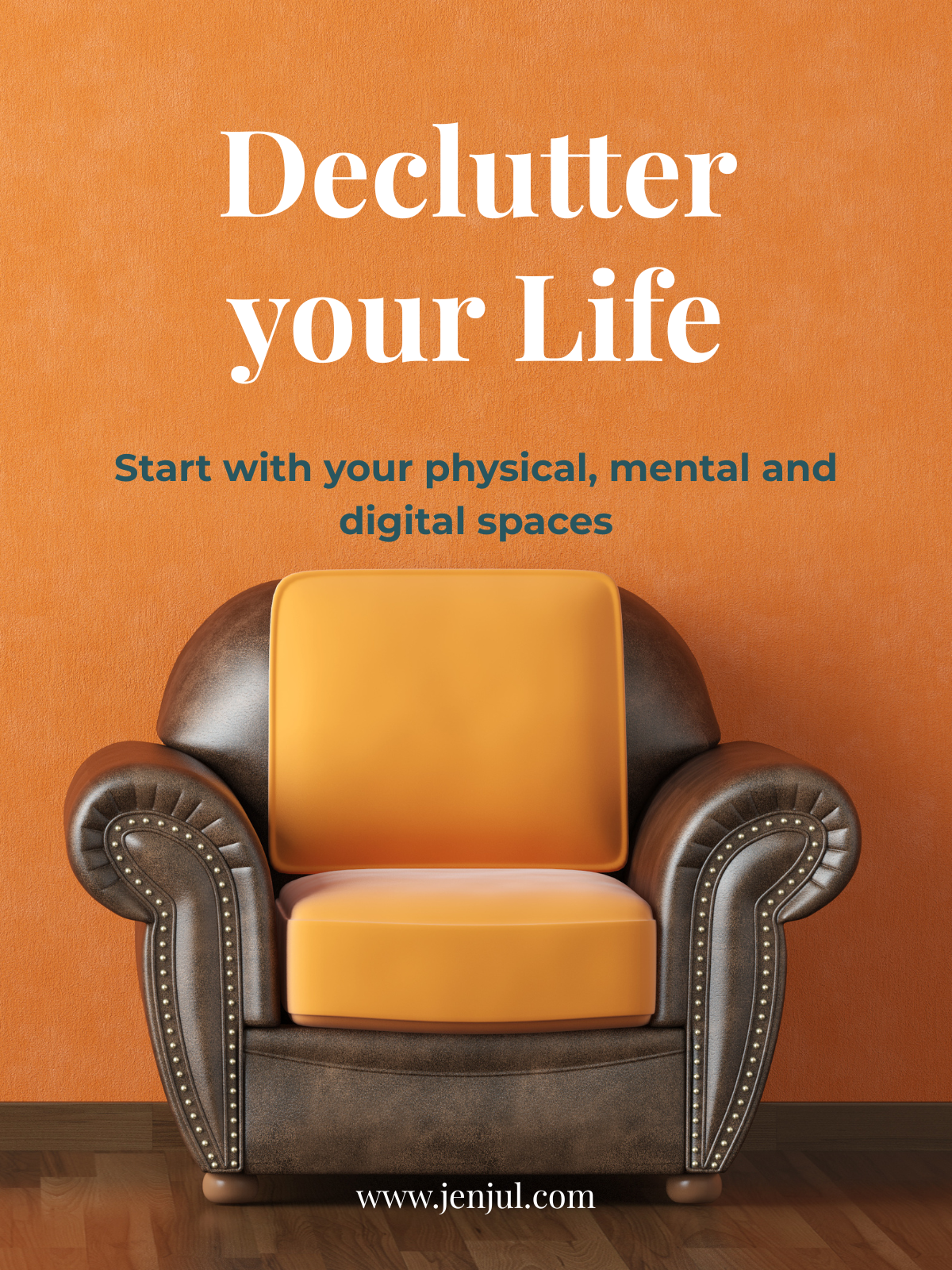
As outlined in Declutter Your Mind and Space, starting with one room or surface at a time creates momentum without overwhelm.³
You are not trying to impress anyone.
You are trying to come home to yourself.
The invisible weight of digital clutter
Digital clutter is often the most exhausting because it never looks messy.
-> Unread emails.
-> Constant notifications.
-> Apps you no longer use.
-> Feeds that keep pulling your attention outward.
Research on technostress shows that constant digital stimulation contributes to emotional exhaustion, reduced focus, and ongoing low-level anxiety.⁴
Your brain was not designed to process this much input without pause.
A rooted digital declutter is not about quitting technology.
It is about regaining agency.
This can look like:
- Turning off non-essential notifications
- Unsubscribing from emails that drain you
- Removing apps that keep you in comparison loops
- Creating phone-free moments in your day
Even small digital boundaries have been shown to create noticeable psychological relief.³
Less input.
More presence.
Mental clutter is where everything finally slows down
Mental clutter is the hardest to see and the hardest to release.
It sounds like:
• Running through tomorrow while still in today
• Replaying conversations long after they end
• Holding unfinished decisions in your body
Psychological research shows that unresolved mental tasks and constant decision-making increase cognitive fatigue and emotional strain.⁵
This is why decluttering your mind is not about “thinking positive.”
It is about creating space.
Practices like journaling, mindful awareness, and simplifying daily decisions help reduce mental load and support emotional regulation.⁶
The goal is not to empty your mind.
It is to organize it gently.³
Decluttering is not a one-time event
This matters.
Decluttering is not something you finish.
It is something you return to as you change and grow.
Life expands. Seasons change. Responsibilities shift.
Rooted living does not mean controlling your environment.
It means regularly asking:
-> What is taking more than it gives?
-> What no longer fits who I am now?
-> What needs space to soften?
Decluttering becomes a rhythm, not a project.
How decluttering creates a rooted life
When physical, digital, and mental clutter decrease, something subtle happens.
Your body settles. Your decisions slow down. Your attention comes back home.
You feel more like yourself again.
You can enjoy your spaces again.
This is the foundation of rooted living.
Not aesthetics.
Not perfection.
But room.
Room to listen. Room to rest. Room to choose intentionally.
Where Rooted goes deeper
Decluttering clears space.
Rooted helps you decide what fills it.
The Rooted Guide expands beyond decluttering into:
- Nervous-system-safe pacing
- Reclaiming time and energy
- Aligning work, home, and income with wellbeing
- Returning to presence in everyday life
Decluttering clears the ground.
Rooted helps you plant what lasts.
A gentle place to start today
If everything feels like too much, start here:
-> Clear one surface.
-> Silence one notification.
-> Write one honest sentence about what you need right now.
That is enough.
That is how rooted living begins.
References
¹ McMains, S., & Kastner, S. (2011). Interactions of top-down and bottom-up mechanisms in human visual cortex. Journal of Neuroscience, 31(2), 587–597. https://doi.org/10.1523/JNEUROSCI.3766-10.2011
² Saxbe, D. E., & Repetti, R. L. (2010). No place like home: Home tours correlate with daily patterns of mood and cortisol. Personality and Social Psychology Bulletin, 36(1), 71–81. https://journals.sagepub.com/doi/10.1177/0146167209352864
³ Jul, J. (2024). Declutter your mind and space: A checklist to identify and tackle areas of your life that need decluttering. Jen Jul. https://jenjul.com
⁴ Tarafdar, M., Cooper, C. L., & Stich, J.-F. (2019). The technostress trifecta: Techno eustress, techno distress and design. Information Systems Journal, 29(1), 6–42. https://onlinelibrary.wiley.com/doi/10.1111/isj.12169
⁵ Baumeister, R. F., Vohs, K. D., & Tice, D. M. (2007). The strength model of self-control. Current Directions in Psychological Science, 16(6), 351–355. https://journals.sagepub.com/doi/10.1111/j.1467-8721.2007.00534.x
⁶ Kabat-Zinn, J. (2013). Full catastrophe living. Bantam Books.

